
EUROPEAN SUPPLY CHAINS: THE POWER TO SEE, THE DUTY TO ACT
Mapping supply chains defends jobs, climate and sovereignty. Build Europe’s digital twin—don’t let others map us first.

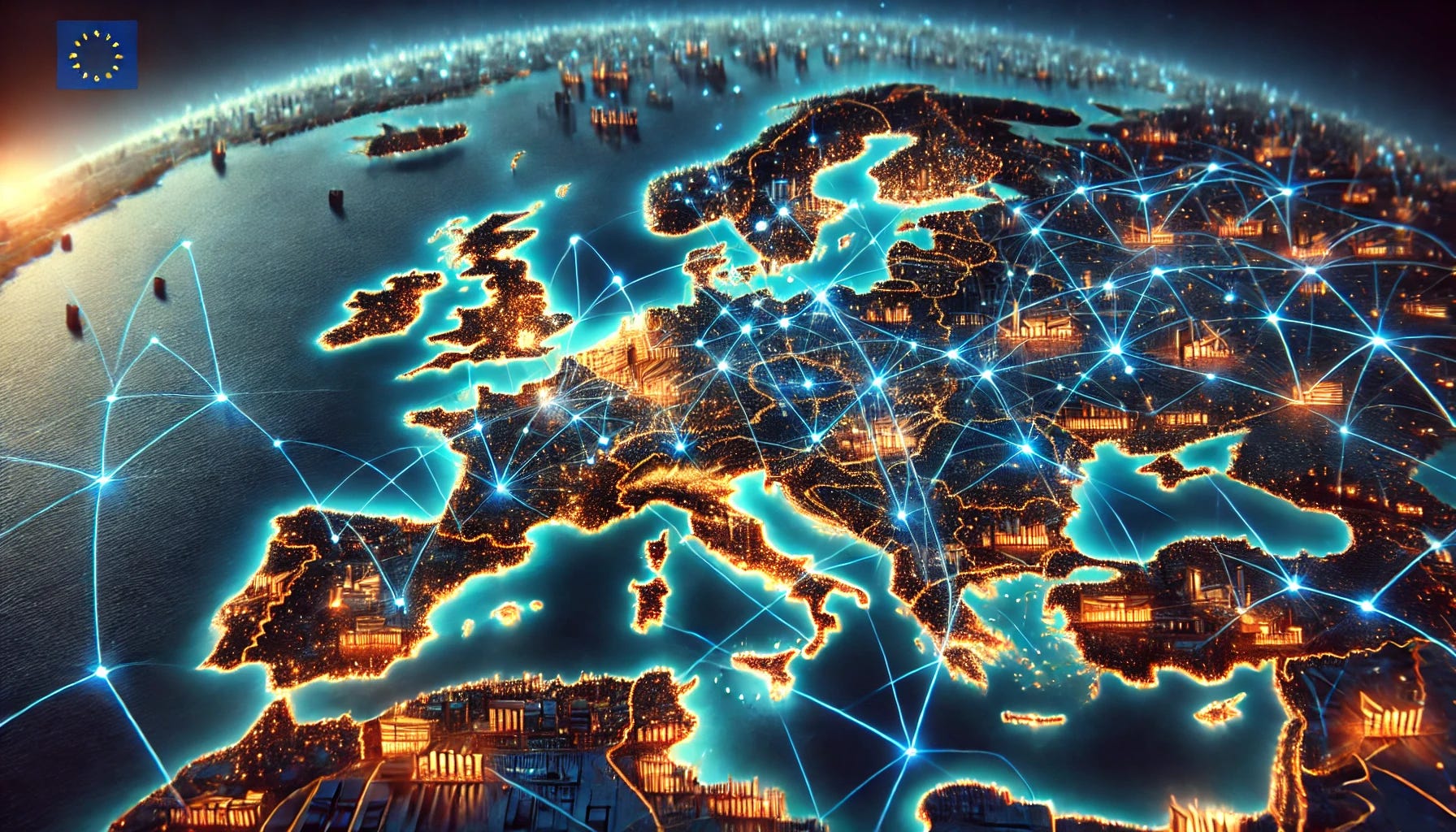
The European economy often resembles, in public debate, an abstraction made up of GDP, inflation, interest rates, and deficits. What is less visible are the thousands of invisible threads that connect a foundry in Slovakia to an automotive subcontractor in Spain, a data center in Ireland to a semiconductor manufacturer in Germany, an Italian agri-food SME to a packaging supplier in Poland. These threads are the supply chains at the company level, the true metabolism of the real European economy.
For a long time, this metabolism remained opaque. We were content with sectoral averages, large statistical categories, input-output tables that described an economy as an aggregation of sectors. Today, technology is changing the game: it is possible to map supplier-customer relationships between companies, almost in real time, and to build a digital twin of the European economy capable of simulating shocks, identifying fragilities, and testing public policies before imposing them in the real world.
At a time when geopolitical fragmentation is accelerating, and dependence on critical inputs and non-European digital infrastructures has become a weapon, the ability to understand one’s own supply chains is no longer an intellectual luxury. It is a matter of sovereignty. The United States, the United Kingdom, China, and large private financial institutions are already massively investing in this “value chain intelligence.” Europe, on the other hand, risks discovering that its own vulnerabilities will be revealed... by others.
It is precisely to avoid this silent downgrading that an analysis submitted to the ECON committee of the European Parliament argues for making supply chain data a true strategic asset of the Union by building a European capacity for value chain intelligence.
SUPPLY CHAINS: FROM THE MYTH OF THE CHAIN TO THE REALITY OF THE NETWORK
We still talk about “value chains” as if production followed a straight line: raw materials, transformation, components, assembly, distribution. This image may still make sense for a workshop or a production line. It no longer makes sense at the level of the economy as a whole.
At the scale of the continent, what is called a supply chain is in reality a gigantic network: millions of companies connected by flows of goods, services, data, intellectual property. Each company is not a link but a node, connected to 30 to 50 suppliers and customers on average, and many more for large groups. Some, like car manufacturers or semiconductor manufacturers, work with tens of thousands of supplier sites around the world.
This network is neither simple, nor linear, nor stable. It has some decisive characteristics for European economic policy. First, extreme heterogeneity: where many SMEs have only a few partners, a small number of firms occupy highly central positions, with a multitude of upstream and downstream links. These are the ones that, in the event of a shock, can drag entire sectors of the economy with them.
Next, a permanent dynamic: every year, a significant portion of supply relationships disappears or is recomposed. Around a “core” of long-term relationships vital for production continuity, there is a cloud of more opportunistic, more volatile relationships. This constant movement makes the boundary between efficiency and resilience much more subtle than is often said: the ability to “rewire” quickly can both reduce costs and strengthen resilience... provided we know where the real bottlenecks are.
This is where the old opposition between “cost optimization” and “costly redundancies” proves deceptive. Resilience is not the moral property of a few virtuous companies; it is an emergent phenomenon of the entire network. An economy can be very efficient in the short term and extraordinarily vulnerable to the slightest disruption at a critical node. Without visibility on the entire network, no one – neither an isolated company, nor a sectoral ministry – can know which relationships are truly systemic.
FROM THE GENERAL MAP TO THE DIGITAL TWIN: THE DATA REVOLUTION
For decades, knowledge of economic interconnections was limited to input-output tables: flows between sectors (automotive, chemicals, services, etc.) aggregated for a country, sometimes for a few major regions of the world. Useful for macroeconomic analysis, but dramatically insufficient to grasp the reality of dependencies.
For the past decade, three silent revolutions have changed everything. The first is that of commercial and administrative data: VAT data, electronic invoicing, company registers, customs statistics, banking information, private databases on supplier-customer links. These deposits, properly harmonized, make it possible to reconstruct real networks of transactions between companies, with almost exhaustive granularity at the national level, and potentially at the European level.
The second revolution is technical: advances in big data processing, complex network modeling, but also secure computing infrastructures make it possible to work on graphs containing millions of nodes and links, with high-frequency simulations.
The third revolution is cognitive: artificial intelligence now makes it possible to extract dependency relationships from unstructured texts – annual reports, press releases, websites, regulations – and to enrich transactional databases with qualitative information on the nature of the links (supply of raw materials, logistical services, software licenses, engineering, etc.).
The combination of these three movements paves the way for what the authors of the analysis call a “digital twin” of the economy: a dynamic and granular representation of supply networks, capable of simulating shocks, measuring risks, testing policies in silico before implementing them in the real world.
REVEALING DEPENDENCIES AND BREAK POINTS
The first utility of such a digital twin is to make visible dependencies that, today, escape almost everyone. Most companies do not know who their suppliers’ suppliers are, nor their customers’ customers. Only a minority of them claim to have complete visibility beyond the first tiers of their value chain.
Yet, recent crises – pandemic, war in Ukraine, tensions over semiconductors, shortages of electronic or pharmaceutical components – have shown that the effects of propagation do not follow either administrative or sectoral boundaries. A localized earthquake or the closure of a decoy factory on the other side of the world can reduce the activity of European firms that have no direct link with the affected area, simply because a second or third-tier supplier is paralyzed.
By defining, for each company, a systemic risk index that measures the share of national production potentially affected by its failure, it becomes possible to identify a “systemic core” of firms whose robustness is a matter of general interest. It is not just the largest in terms of turnover. Some medium-sized companies, but occupying bottleneck positions in the network, can be much more crucial for the continuity of the economy than a highly visible but easily substitutable champion.
Similarly, we can identify “strategic dependencies” on third countries, not only in terms of import volumes by sector, but in terms of concrete links: which critical components, which logistical services, which technological inputs are provided by an extremely restricted number of non-European actors, to which nodes of the network are they connected, and what alternatives would be available in the event of a disruption?
Making these dependencies visible is already taking back power: the power to prioritize, to negotiate, to diversify, to target public interventions where they have the most effect for collective resilience.
FROM RESILIENCE TO DECARBONIZATION: TESTING POLICIES IN SILICO
But the power of such a tool does not stop at risk monitoring. By using propagation simulations in the network, it becomes possible to test ex-ante policies that, until now, have largely relied on intuition or very approximate aggregated models.
The example of decarbonation is particularly illuminating. If we merely impose uniform constraints on the largest emitters, without considering their position in the network, we risk obtaining the worst of both worlds: costly emission reductions in terms of jobs and production, with very poorly controlled propagation effects.
By cross-referencing, for each company, its direct CO₂ emissions with its centrality in the network and the number of jobs dependent on its activity, it becomes possible to identify “climate leverage points”: highly emitting companies but not very systemic, on which it is socially less costly to impose rapid transformations; central companies for employment and production, on which we must, on the contrary, provide more support, invest in technological alternatives, plan the transition over time.
We can then compare different scenarios leading to the same emission objective, but with very different consequences for employment, income, and territorial stability. In some simulation exercises, a blind strategy leads to massive job and production losses, whereas a strategy based on network intelligence achieves the same emission reduction with losses divided by ten.
Similarly, we can test the impact of customs measures, export restrictions, sectoral embargoes, new regulations (for example on due diligence or critical raw materials) before implementing them, by identifying in advance bottlenecks, the sectors, the regions that will be most affected and the compensations to be provided.
A NEW GEOPOLITICS OF SUPPLY CHAIN DATA
What is being put in place on a global scale is a true geopolitics of knowledge of supply chains. Major investment banks and financial information providers, armed with proprietary data and AI, are already reconstructing detailed maps of supplier networks. They use them to assess the robustness of business models, price risks, design derivative products, advise large groups on their locations and strategies.
At the same time, states are developing their own public infrastructure for intelligence on value chains. The United Kingdom, with its “Global Supply Chain Intelligence” program, seeks to integrate customs data, company registers, geospatial information, and transactional flows to identify, in near real time, critical vulnerabilities and guide its industrial strategy and crisis responses. The United States uses a range of tools – from the Defense Production Act to industrial base analysis programs – to monitor its dependencies in semiconductors, batteries, pharmaceuticals, and critical metals. China, finally, has long integrated the systematic collection of data on inter-company flows into its tools for industrial planning, credit control, and commercial policy.
The risk for Europe is clear: without its own capacity, it would become both dependent on inputs produced elsewhere and dependent on information produced elsewhere about its own supply chains. In other words, not only vulnerable in its production but vulnerable in its knowledge. In the world of data, not seeing one’s own economy means accepting that others see it better than you, and thus that they can play a step ahead in every crisis, every negotiation, every industrial battle.
TOWARDS A EUROPEAN CAPACITY FOR SUPPLY CHAIN INTELLIGENCE
Faced with this observation, the analysis submitted to the European Parliament does not merely paint a pessimistic picture; it proposes a very concrete course of action: to build a true European capacity for supply chain intelligence, based on a clear legal framework and a dedicated institution.
First, it would be about creating a “European Institute for Supply Chain Intelligence,” with an explicit mandate: to collect, harmonize, secure, and analyze the data on inter-company transactions necessary for monitoring production networks, in the general European interest. Member states would transmit, in pseudonymized form and within a high-security framework, VAT data, electronic invoicing data, customs data, and other relevant administrative sources. The institute would work in a federated architecture where necessary, centralized where the law allows, relying on advanced data protection techniques (federated computing, pseudonymization, strict access control, request traceability).
This institute would not be a simple “data safe.” It would bring together multidisciplinary teams – economists, network specialists, data engineers, sectoral experts – capable of transforming this data into operational tools: sectoral dependency maps, systemic risk indices, shock simulators, dashboards for ministries, supervisory authorities, crisis management agencies.
A solid governance system would be essential: parliamentary oversight, a council bringing together member states, the Commission, and independent experts, an ethics and data protection committee, public access registers. The purposes of use should be precisely defined: crisis preparation and management, industrial and commercial policy, taxation, ecological transition, sustainability monitoring, support for the implementation of regulations such as the due diligence directive.
Beyond these initial functions, the secondary benefits would be considerable: improving the fight against VAT fraud and carousel fraud schemes, which would strengthen tax fairness and generate revenue; radical simplification of compliance with supply chain obligations for businesses, particularly SMEs; the ability to track carbon flows and raw materials through value chains, facilitating the design of intelligent and socially sustainable decarbonation policies.
AN OPPORTUNITY FOR A GREEN AND SOCIAL INDUSTRIAL STRATEGY
The issue goes beyond mere risk management. Used wisely, supply chain intelligence can become one of the key instruments of a green, social, and democratic European industrial strategy.
In terms of climate transition, it would allow targeting incentives, constraints, and support on the nodes where the most emissions can be reduced with the least social damage. Rather than imposing uniform standards that blindly strike sectors and territories, we could design differentiated trajectories, aligned with the realities of production networks, anticipating potential job losses and organizing, upstream, training, conversions, alternative investments.
In terms of social and territorial policy, a detailed knowledge of interconnections would make it possible to identify which employment basins depend on which suppliers, which customers, and how a closure or relocation would resonate in the local fabric. Public authorities could thus move away from the logic of day-to-day management, where damage is discovered once the social catastrophe is triggered.
Finally, in terms of regulation, this capacity would allow us to move away from the current dilemma between normative inflation and ineffectiveness. Too often, the European Union produces ambitious regulations on paper – whether on due diligence, critical raw materials, or sustainable finance – but without having the concrete tools to verify their real effect on production networks. The result is a piling up of declarative obligations for companies, particularly the smallest ones, with limited impact on deep structures. True intelligence of chains would, on the contrary, make it possible to draw up an objective assessment of policies, adjust them, simplify where the effect is nil, and strengthen where the impact is demonstrated.
CONCLUSION
We have entered a world where knowing the networks means commanding the economy. Where, yesterday, strategic advantage lay in access to raw materials or capital, today it increasingly lies in access to data and the ability to extract a coherent vision of the productive system from it.
Europe lacks neither data, nor researchers, nor institutions capable of guaranteeing the protection of fundamental rights. What it still lacks is the political decision to erect its supply chain data as a common strategic asset, in the service of its sovereignty, its ecological transition, and its social cohesion. Leaving this field to private actors and external powers alone would mean accepting that the industrial, climatic, and social choices of the Union are made in semi-darkness, with a step behind those who, elsewhere, see the networks being drawn in real time.
Building a European capacity for supply chain intelligence is the opposite of planning nostalgia: it is not a return to a managed economy, but equipping an open, complex, and interdependent economy with the instruments of clarity it needs to remain the master of its destiny. This requires political courage, institutional investment, and a demanding democratic debate on the use of data. But the price of inaction would also be colossal: a gradual weakening of competitiveness, a succession of crises suffered rather than prepared for, a chaotic and socially unjust ecological transition.
The Union has a choice. Either it accepts being mapped by others and reacts to their maps. Or it draws, itself, the digital twin of its economy and gives itself the means to anticipate, protect, and transform. In a century where power is also measured by the quality of the intelligence deployed on one’s own networks, this is a choice of sovereignty in the fullest sense.
For information: EuroScope Substack
#SupplyChains #EconomicSovereignty #Resilience #Competitiveness #EcologicalTransition #IndustrialPolicy #Data #EuroScope