
CARBON BORDER ADJUSTMENT MECHANISM: THE FIRST 2026 PRICE ENTERS THE STAGE
Europe’s carbon border policy now has a number: €75.36 per certificate for Q1 2026. The debate leaves theory and enters costs, trade and industrial strategy.

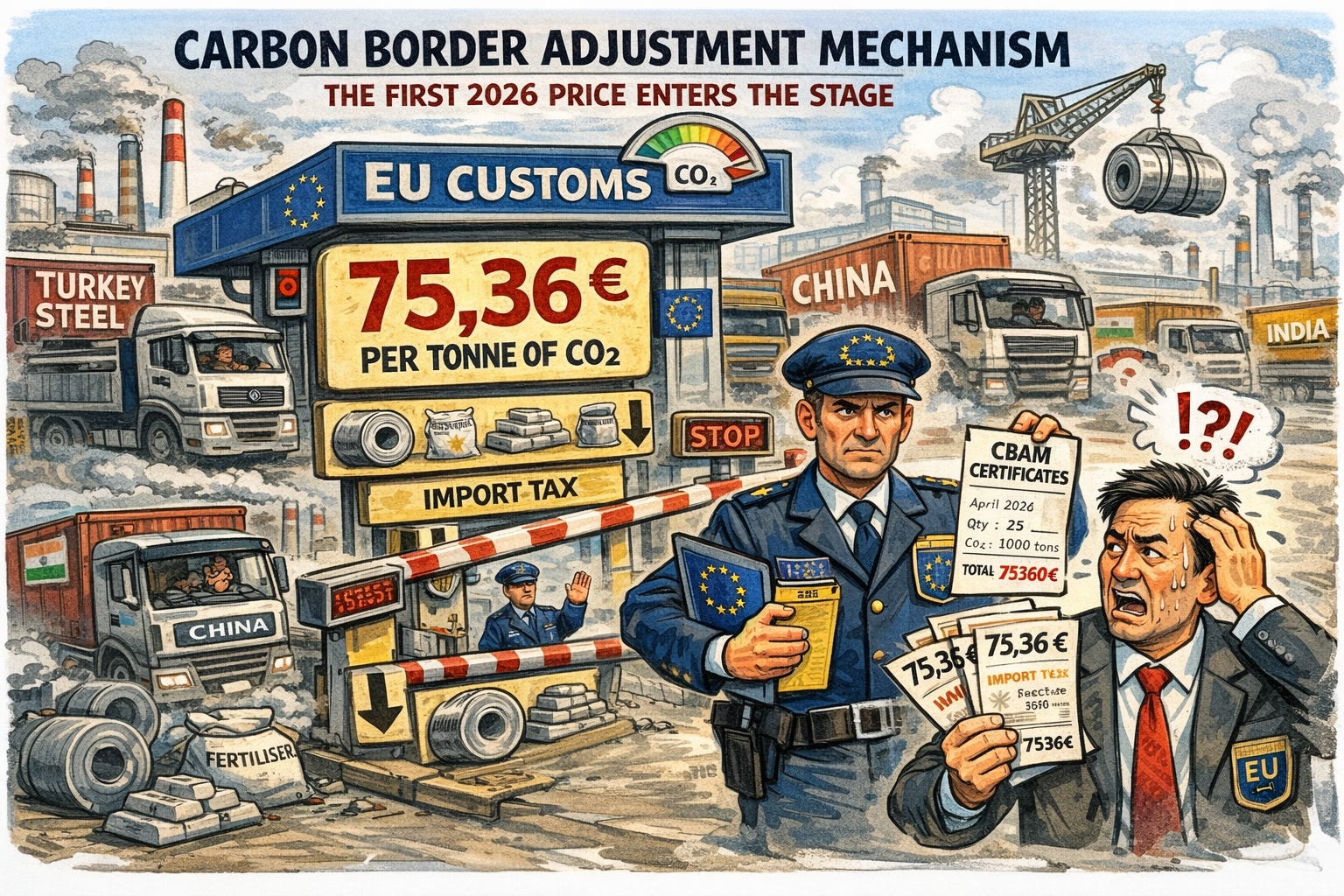
On April 7, 2026, the European Commission published the first unit price of certificates under the carbon border adjustment mechanism for imports made in the first quarter of 2026. This price stands at 75.36 euros per certificate. It corresponds to the average auction prices of allowances under the European Union emissions trading system. This first milestone finally gives the CBAM its concrete monetary translation. Until now, the debate had often remained legal, technical, or doctrinal. It now becomes accounting, industrial, and commercial.
A PRICE SIGNAL THAT CHANGES THE NATURE OF THE MECHANISM
The CBAM is no longer merely a preparatory mechanism. The transitional phase, opened on October 1, 2023, ended at the close of 2025. Since January 1, 2026, the Union has entered the definitive regime. The principle is clear: imports of highly emitting goods must now be linked to a carbon cost consistent with that borne by European production. The Commission recalls that the mechanism aims to put a fair price on the carbon embedded in imported goods and to encourage cleaner production outside the Union. We are therefore moving from a logic of declaration to a logic of economic responsibility.
THE CORE OF THE SYSTEM: ALIGNING IMPORTS WITH THE EUROPEAN CARBON MARKET
The price of 75.36 euros is not arbitrary. It is calculated on the basis of the European ETS market. The Commission specifies that in 2026 the prices of CBAM certificates will be published every quarter, before moving to a weekly calculation from 2027 onward. The timetable is already fixed: the price for the second quarter will be published on July 6, 2026, that for the third quarter on October 5, 2026, and that for the fourth quarter on January 4, 2027. This architecture shows Brussels’ political objective: to make the CBAM an external extension of the European carbon signal, so that the import of carbon-intensive products can no longer bypass the climate cost borne within the single market.
A FINANCIAL BURDEN STILL DEFERRED, BUT ALREADY FRAMED
One point deserves to be underlined. The Commission is publishing prices as early as 2026, but the actual purchase of certificates will only begin from February 2027 on the common central platform. This sequence has a precise function. It gives operators an official benchmark, reduces the risk of divergent private estimates, and allows companies to prepare their purchasing, reporting, and hedging strategies. In other words, the Union is not postponing the constraint. It is announcing it, quantifying it, and installing it gradually in order to make the framework more readable and more difficult to contest.
THE TARGETED SECTORS AND THE REALITY OF THE FIRST FLOWS
The mechanism currently covers cement, iron and steel, aluminium, fertilisers, electricity, and hydrogen. The first operational data published by the Commission after the entry into force of the definitive regime already show a clear reality: over the window running from January 1 to 6, 2026, 98% of the declared volumes related to iron and steel. The main countries of origin then included Turkey, China, India, Canada, Taiwan, and Vietnam. On the side of importing Member States, Belgium, Spain, Romania, the Netherlands, France, and Germany appeared at the top. This snapshot says one simple thing: in its first concrete materialisation, the CBAM is above all an instrument of industrial rebalancing applied to metallurgical value chains.
A REFORM THAT COMBINES CLIMATE, INDUSTRY, AND CUSTOMS
The CBAM is often presented as a climate tool. That is correct, but incomplete. It is also an instrument of industrial policy, trade policy, and regulatory sovereignty. The Commission presents it as a means of preventing carbon leakage, that is to say the relocation of production to countries where climate constraints are weaker, or the replacement of European products by more carbon-intensive imports. The mechanism is also part of a trajectory linked to the gradual disappearance of free allocation of allowances in the sectors concerned. The underlying idea is crystal clear: Europe no longer wants to bear the cost of its decarbonisation alone while its competitors retain an implicit carbon advantage at the entrance to the European market.
AN IMPLEMENTATION THAT SEEKS TO LIMIT THE ADMINISTRATIVE COST
Brussels has nevertheless admitted that such a mechanism could become too burdensome for small importers. That is why a reform adopted in 2025 introduced a mass threshold of 50 tonnes per year, intended to exempt a large share of small operators, while still keeping more than 99% of emissions within the mechanism’s scope according to the Commission. It estimates that nearly 182,000 importers, mainly SMEs and private individuals, will thus leave the scope of obligation. This choice shows that the European line is not that of blind bureaucracy. It seeks to preserve the climate reach of the mechanism while concentrating the effort on the flows that truly matter in imported emissions.
WHAT THIS FIRST PRICE TELLS US ABOUT THE EUROPE THAT IS COMING
The amount of 75.36 euros is worth more than a quarterly reference. It gives a political indication of the way in which the Union intends to govern the transition. It no longer separates the border, climate, industry, and competition. It treats them in one and the same movement. This means that the single market is entering a phase in which access to the European economic territory will increasingly depend on carbon traceability, the quality of emissions data, compliance with customs procedures, and the ability of companies to integrate the climate cost into their prices. The CBAM therefore does not merely signify the extension of the carbon market. It marks the extension of the European norm into global trade. This reading goes beyond the technical dimension, but it is indeed consistent with the architecture now put in place by the Commission.
CONCLUSION
With the publication of this first quarterly price, the carbon border adjustment mechanism leaves the realm of promises and enters that of amounts, arbitrations, and balances of power. The European Union is sending a clear message both to its trading partners and to its own industrial actors. The time of pedagogy alone is over. The time of pricing begins. For the companies concerned, the challenge is no longer to understand whether the CBAM will matter. The challenge is to measure how much it will weigh on margins, competitiveness, and the reshaping of supply chains. For Europe, this first figure opens a new stage: that of a climate policy that is also defended at the border.
#CBAM #CarbonAdjustment #ETS #EuropeanIndustry #InternationalTrade #Climate #EuropeanUnion #EconomicSovereignty #EuroScope
For information, Commission announcement: Price of CBAM certificates
For information, EuroScope on Substack: EuroScope Substack